The Dream is Still Alive
Mele’s Father’s Cocoa and a New Future for Samoan Food
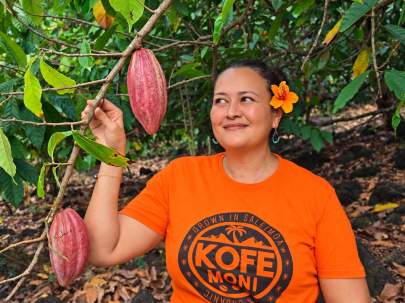
It begins with a father and a cocoa plantation.
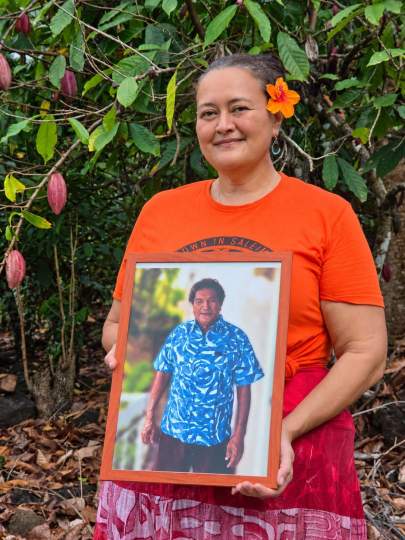
Long before Papali’i Mele Maula became one of Samoa’s most recognisable advocates for women growers, before SWAG markets and jars of chutney and bags of coffee, there was Tuiatafu Nusi Maulaivao and a dream he carried for years.
He wanted to grow cocoa.
Around two decades ago, he began planting. When Mele returned to Samoa some 17 years ago, what had been her father’s dream gradually became hers too.
“My father’s dream was always to have a cocoa plantation,” she says.
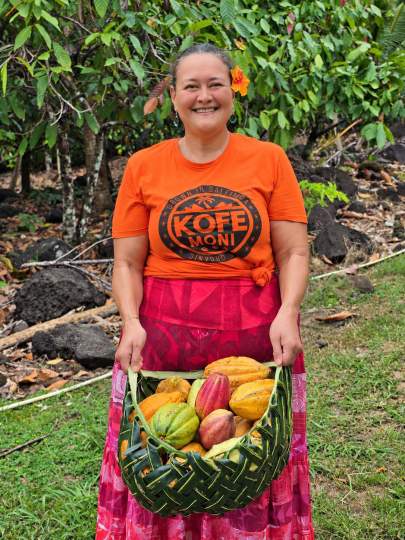
Together, father and daughter built Koko Moni, a small Samoan cocoa enterprise producing Koko Samoa and exporting cocoa beans to chocolatiers abroad. Over the years came coffee, jams, chutneys and whatever else could be made when Samoa’s crops offered up their seasonable abundance.
For Mele, though, Koko Moni was never simply about putting another product on a shelf. It was about memory.
Her father remembered the KoKo Samoa of his childhood, cocoa carefully fermented, properly roasted, and allowed to retain the rich flavour of the bean itself. He believed that when food tasted as it should, there was less need to bury it beneath sugar and preservatives.
“My father was a true visionary,” Mele says. “He handed that vision down to me. I became obsessed with cocoa and organic farming as well.”
Then her voice turns softer.
“Of course, it is hard not having him here anymore, but the dream is still alive.”
The dream now travels well beyond the family plantation.
Mele is co-founder and secretary of the Samoa Women’s Association of Growers or SWAG and one of six women entrepreneurs from Fiji and Samoa participating in the Idea2Market Regenerative Bioeconomy Initiative, supported by The Asia Foundation and delivered in partnership with Pacific Island Food Revolution and Seniman Pangan.
At its heart is a strong proposition: some of the Pacific’s greatest economic opportunities may already be growing in our backyards, plantations, and villages. The question is what we do with them.
Mele gives the example of mango season.
“When it is mango season, everybody has mango,” she says.
The trees are heavy with fruit, supply is everywhere and the opportunity to earn much from selling fresh mangoes disappears almost as quickly as the season itself.
But turn those mangoes into jam or chutney and everything changes.
“You have a longer shelf life,” she says, “and you also have the ability to increase the profit margin.”
A fruit that might once have fallen from a tree and spoiled can become something bottled, branded, sold and carried into a hotel kitchen, retail store or perhaps, one day, an overseas market.
For the women of SWAG, this thinking is already familiar.
The organisation was born partly from frustration. Mele and other women growers saw agricultural workshops and activities taking place around them but noticed that women were not always in the room.
Agriculture, like so many industries, had acquired a gender. Even the work ‘farmer’ carried assumptions.
“When you say ‘farmer’, many times people presume that is either a gendered male role or that only men are farmers,” Mele says.
So, they chose another word. Grower.
“A grower is anybody who can grow anything. Whether you have a box of soil outside your house or a 20-acre plantation, the point is that you can grow.”
And from growing food, she says, something larger can grow, too.
“You can grow business, you can grow income, and you can grow in ways that empower you and help support your family and your community.”
SWAG became a place where that philosophy would live.
Women – and, Mele points out with a laugh, a membership that is also around 30 per cent male – come together to learn about organic farming, composting, online marketing and food processing. They swap knowledge, encourage one another and turn papaya, mango, coconut, and other local ingredients into products with longer shelf lives and greater value.
“Everybody holds everybody else’s hand so nobody succeeds alone,” Mele says. “We do it together.”
That sense of possibility followed her to Indonesia through the Idea2Market initiative. There, Mele encountered an approach to food enterprise that felt new and deeply familiar: indigenous knowledge treated not as something old-fashioned to be discarded, but as an asset from which businesses could be built.
She was particularly inspired by Javara and its founder, Helianti Hilman. Javara is a social enterprise that works across the entire agricultural value chain, from production and processing to branding and distribution. Its mission is to preserve Indonesia’s indigenous food biodiversity.
“To see the ways in which they bring innovation and marry it with indigenous cultural knowledge is very exciting,” Mele says. “It makes absolute sense for the Pacific and specifically for Samoa as well.”
She returned imagining what Samoa might build: a cooking centre, a learning centre, a place where growers could walk in with an ingredient and walk out understanding how to turn it into something more.
The urgency of that work is becoming harder to ignore.
Outside Mele’s home in Siusega, rain fell during the interview. It should have been the dry season.
“Climate change is a reality, and we live it as farmers,” she says.
Avocados that could once be harvested in November are now appearing months later. Seasons are moving. Growers notice because their incomes move with them.
For women whose livelihoods depend on the land, learning to preserve food, diversify products and reach new markets is not merely entrepreneurship. It is protection against an increasingly unpredictable future.
And yet, through everything – climate, markets, business and the work of strengthening SWAG – Mele keeps returning to her father.
She wants Koko Moni to become something people recognise and love. She wants the knowledge he accumulated to travel beyond their plantation.
“I cannot keep all the information to myself,” she says.
Five years from now, she hopes to have grown into a stronger more independent grower herself. And she hopes that somewhere along the way she will have done something that every child carrying a parent’s unfinished dream eventually has to do: honour what was handed to her while finding the courage to make it her own.